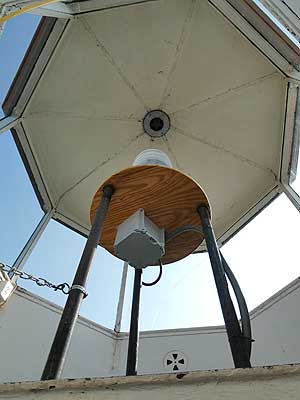
-- DULUTH SHIP CANAL --
The St. Louis River feeds into Superior Bay before emptying into Lake Superior. Unfortunately two long, narrow sandbars (the 7-mile-long Minnesota Point and 3-mile-long Wisconsin Point) made shipping more difficult, with the only natural entry to the lake being several miles away from the harbor. So in the 1870s, the 300-foot-wide Duluth Ship Canal was cut through the Minnesota Point . Upgrades to the two breakwaters created a north pier (1901) and a south pier (1900). These contain three lighthouses: the north pier light and the south pier outer and inner lights.
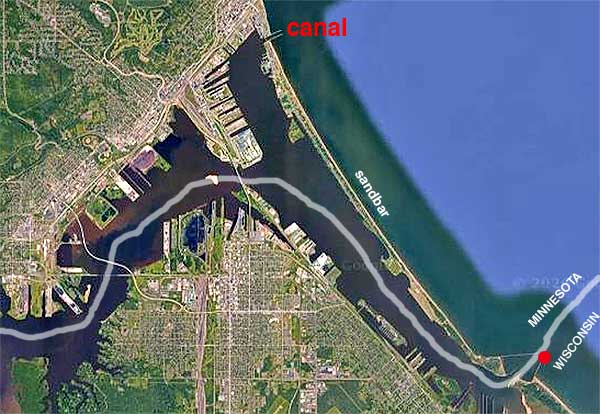
The Duluth ship canal with three lights and the Superior Entry Breakwater Lighthouse (red dot). The while line is the state border.
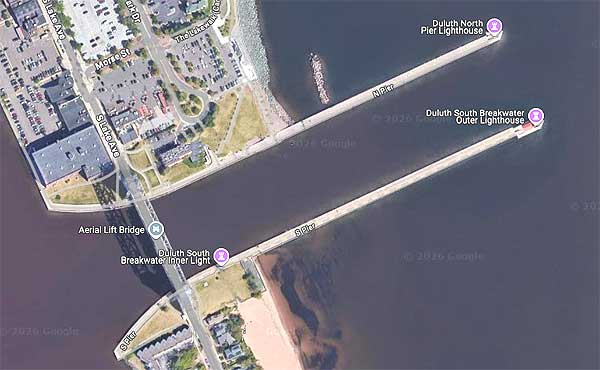
A close-up of the ship canal with the three lights
-- DULUTH HARBOR SOUTH BREAKWATER OUTER LIGHT --
Lake Superior, Duluth Ship Canal
Built 1874 (rebuilt 1901) • Height 34 feet • 4th order lens
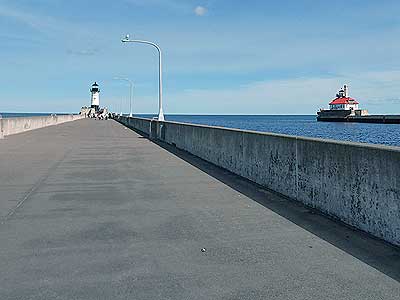
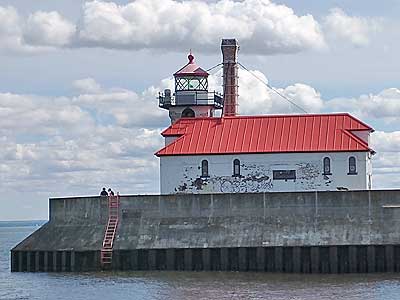
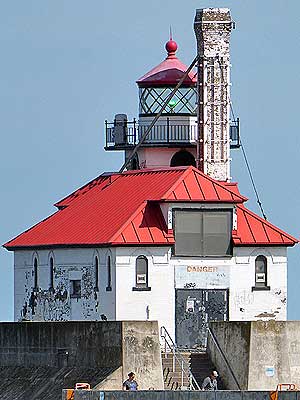
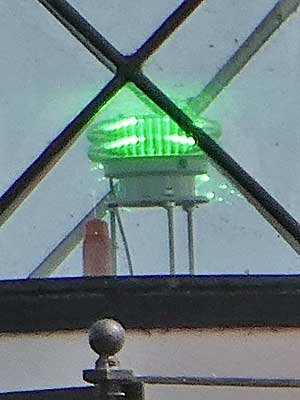
A 34-foot-tall square-sided iron lighthouse on the outer end of the south pier was finished in 1874. It was rebuilt in 1901 and automated in 1976. It used to have a 4th order lens but now has a fixed green light. It serves as a range light together with the south pier inner light.
-- DULUTH HARBOR NORTH BREAKWATER OUTER LIGHT --
Lake Superior, Duluth Ship Canal
Built 1910 • Height 37 feet • 5th order lens
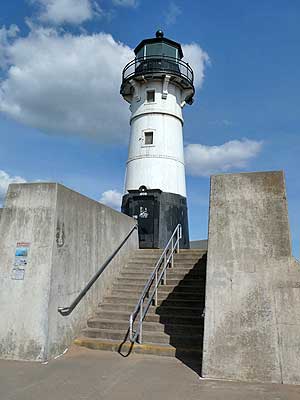
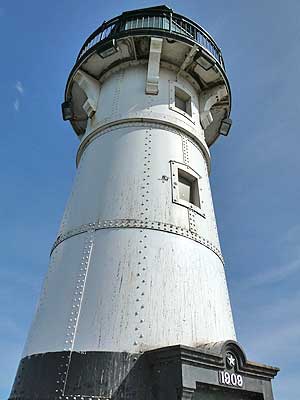
In 1910, a lighthouse was built on the outer end of the north pier. With a height of 37 feet, the tower was constructed using a steel shell over steel columns. It was given a 5th order lens. A motor connected to the city’s electric lighting system was used to drive the clockwork mechanism.
-- DULUTH HARBOR SOUTH BREAKWATER INNER LIGHT --
Lake Superior, Duluth Ship Canal
Built 1889 • Height 70 feet • 4th order lens
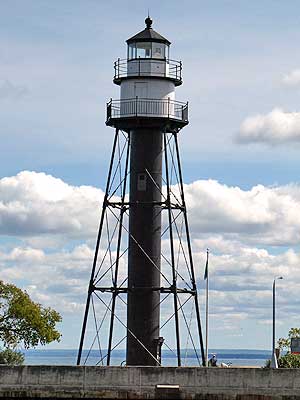
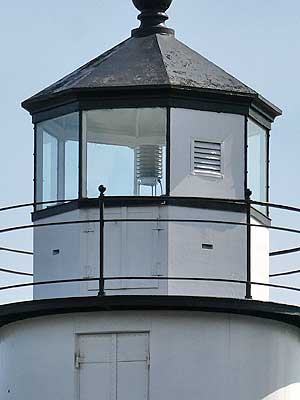
Located at the end of the south pier and the terminus of the Northern Pacific Railroad, the 70-foot-tall steel tower was built in 1889.
-- GRAND MARAIS BREAKWALL --
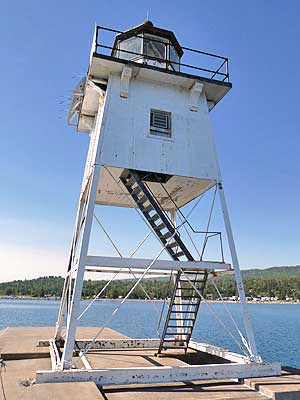
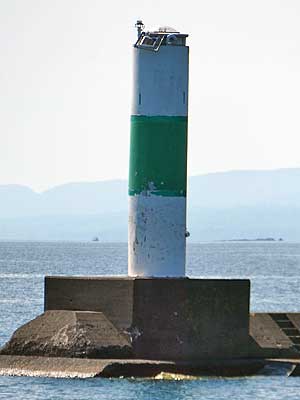
The Grand Marais Breakwall was built after a major shipwreck just outside the harbor in 1881 that killed all of the crew. In 1883, construction was completed on a 300-foot-long wall of rocks on the eastern side of the harbor, offering protection to vessels in search of shelter. During a storm the following year, 11 vessels sought out its safety. A wooden, pyramidal lighthouse was built in 1885. It was constantly damaged by severe storms. The current, operational, white steel tower was lit in 1922.
In 1901, a 350-foot-long breakwater on the western side of the harbor entrance was completed. This is now the location of the Grand Marais Lower Range Light Beacon Station.
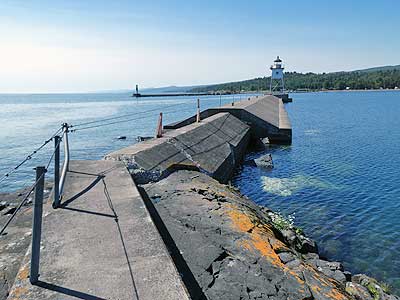
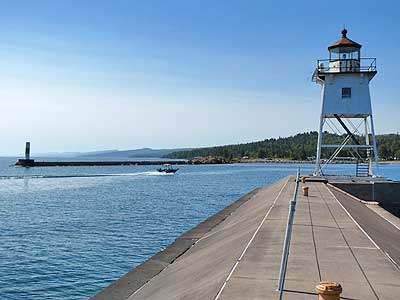
Standing on the eastern breakwall with the western breakwater in the distance
-- GRAND MARAIS LIGHT --
Lake Superior
Built 1922 • Height 34 feet • 5th order lens
-- GRAND MARAIS LOWER RANGE LIGHT BEACON STATION --
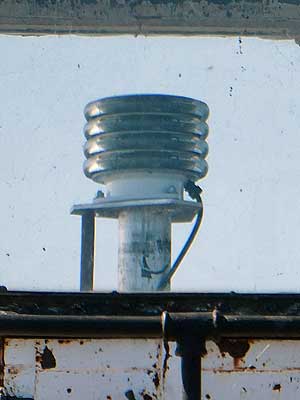
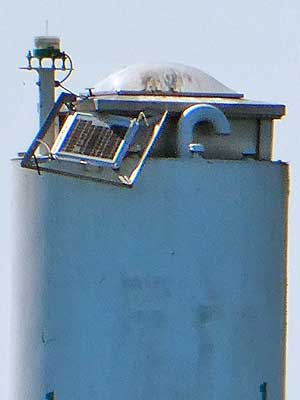
A D-9 cylinder replaced the west breakwater skeletal light in the 1960s.
-- SPLIT ROCK LIGHTHOUSE --
Lake Superior
Built 1910 • Height 54 feet (on 130-foot cliff) • 3rd order lens
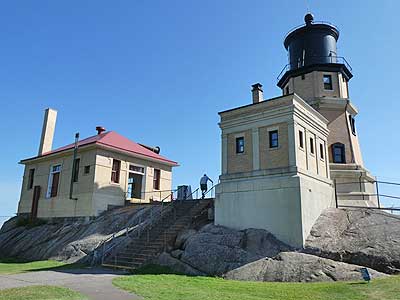
The 54-foot-tall Split Rock Lighthouse was built in 1910 on top of a130-foot cliff. All construction materials had to brought in by water since the highway wasn't completed until 1924. Originally, a hoisting derrick was used. But in 1916, a tramway was added, leading from the landing at the base of the cliff up to a hoist house at the top. A gasoline engine was used to pull a cart up a tracks. In 1969, the light was decommissioned and sat empty for two years it was transferred to the state, at which point it was restored to a 1920s appearance.
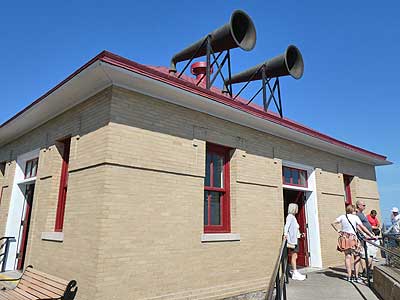
(right) Replica foghorns were placed atop the fog signal building in 1979.
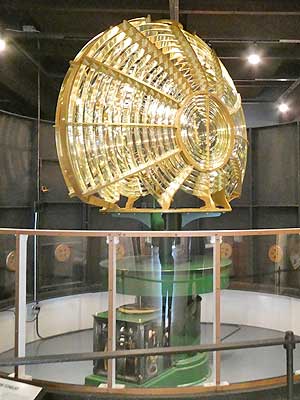
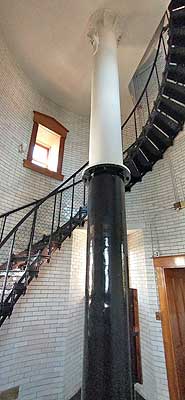
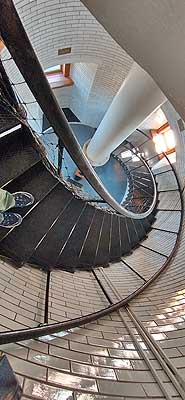
A full-scale replica sits in the museum ... The stairs (looking up and down)
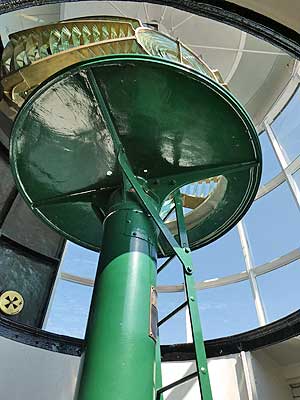
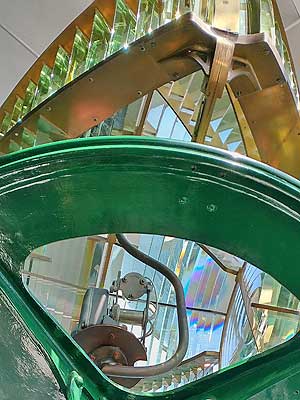
A 3rd order Fresnel lens was installed in 1910. It was composed of 252 individual prisms and its beam was visible for up to 22 miles. It originally used kerosene but switched to a 1,000-watt electric bulb in 1940.
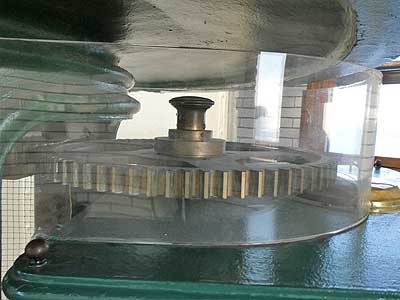
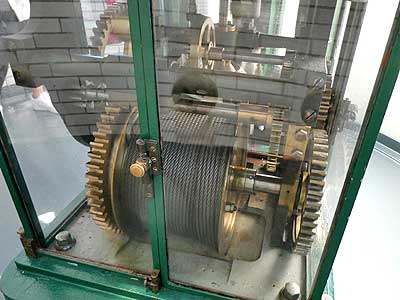
The lighthouse used a clockwork mechanism to revolve the lens. A gear box under the base of the lens pedestal was connected to a cable that hung through the center of the tower and was slowly pulled down by 250-pound weight. It had to be wound by hand every two hours through the night. By the 1890s, the clockwork mechanism floated in 250 pounds of liquid mercury. This enabled it to rotate the heavy lens quickly enough in order to produce the frequent, flashing signal.
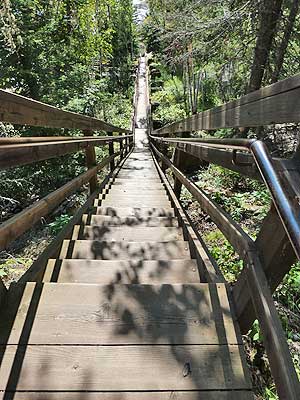
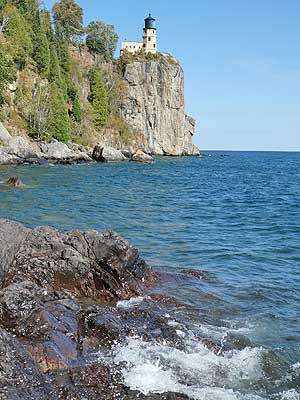
A stairway leading down to the water parallels the remains of the old tramway’s concrete supports. ... The view from the shore
-- TWO HARBORS --
Lake Superior
Built 1892 • Height 49 feet • 4th order lens
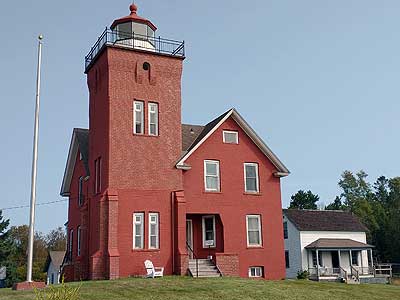
In 1886, it was decided a lighthouse was needed here due the large shipments from the iron ore industry. Construction was completed in 1892. The 49-foot, square tower was built three bricks thick and was equipped with a 4th order lens. In 1907, a revolving four-sided lens replaced the original fixed lens. In 1921, when electricity was introduced, the light’s power increased from 30,000 candlepower to 230,000 candlepower. It was replaced in 1969 with a 24-inch aerobeacon, which was again upgraded in 2020.
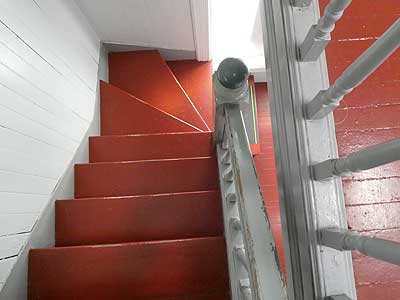
Forty steps wind up through the four stories to the lantern room. Note it isn't the usual curved staircase.