-- CALIFORNIA (San Diego) --
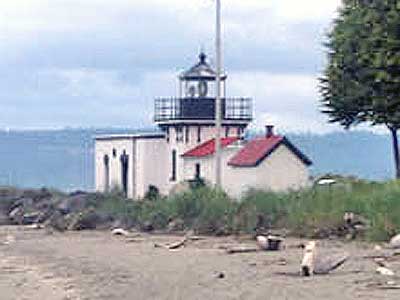
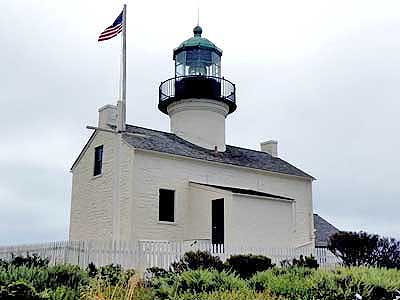
Old Point Loma Lighthouse
San Diego Bay (Pacific Ocean)
Built 1855 • Height 46 feet • 3rd order lens
Completed in 1855, the Old Point Loma Lighthouse had the highest elevation of any lighthouse in the US. At 422 feet above sea level, its light could be seen as far as 39 miles away. Unfortunately, this high elevation turned out to also be its downfall. Low clouds and thick fog often made the 3rd order lens difficult to see. On extremely bad nights, the keeper would sometimes fire off a shotgun to warn ships away.
So in 1891, the New Point Loma lighthouse was built at a lower elevation. The old lighthouse was boarded up and abandoned. The outbuildings disappeared, and vandals broke into the lighthouse and took pieces of it away. There was talk of completely tearing it down. In 1913, however, President Woodrow Wilson dedicated the lighthouse and a half-acre of land as Cabrillo National Monument.
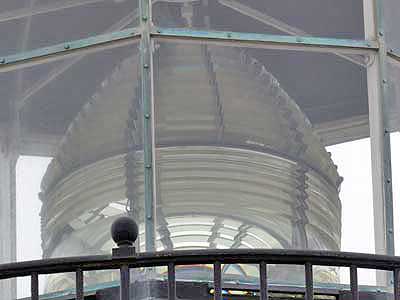
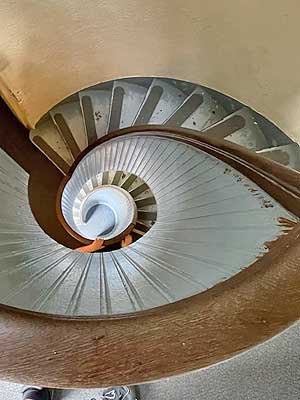
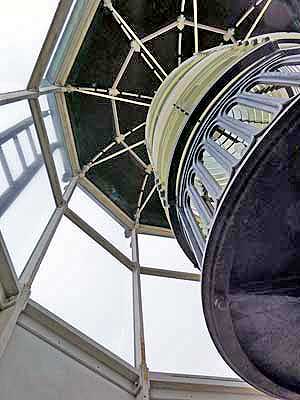
We climbed the tower for a peek into the lantern room.
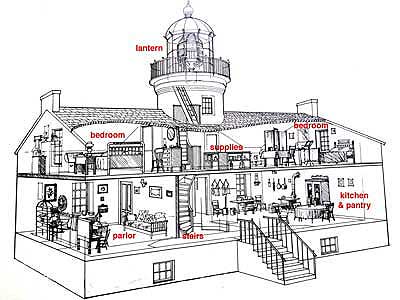
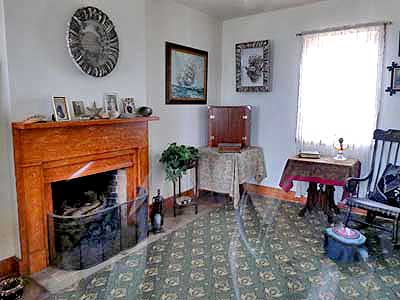
The lighthouse was also the home of the keepers who serviced of the light. Together with their families, they gardened and raised animals. The children rowed across the bay to Old Town each day for school.
New Point Loma Lighthouse
San Diego Bay (Pacific Ocean)
Built 1891 • Height 70 feet • 3rd order lens
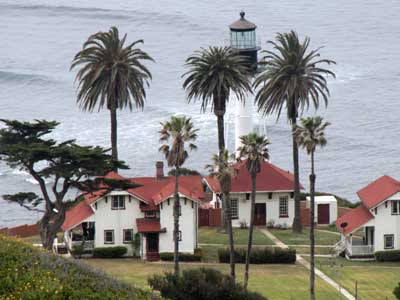
The New Point Loma Lighthouse located at the tip of the peninsula was automated in 1973, and in 1997 the old Fresnel lens was replaced by a new beacon. It is now a residential area for Coast Guard officers and not open to the public.
-- CALIFORNIA (Point Reyes, Marin County) --
Point Reyes Lighthouse
Gulf of the Farallones (Pacific Ocean)
Built 1879 • Height 35 feet • 1st order lens
The first recorded shipwreck on the Point Reyes Headlands was in 1595 of a Spanish galleon seeking shelter from a storm. Despite many more shipwrecks, it wasn't until 1855 that the Point Reyes Lighthouse was authorized to be built here, some 30 miles northwest of San Francisco. But construction was delayed for 15 years while attempts were made to purchase the land. Fourteen more wrecks occurred during this time.
The original plan was to build it on top of the bluff, but extremely strong winds and dense fog are common here. So the 275-foot tower was built on lower terraces carved out of the cliff. All construction material was brought in by boat and hauled up the cliff. It was completed in 1870, electrified in 1938, and concrete steps were built into the cliff in 1939. The station was automated in 1975. The Coast Guard building just below the lighthouse has a modern light and fog signal on the roof.
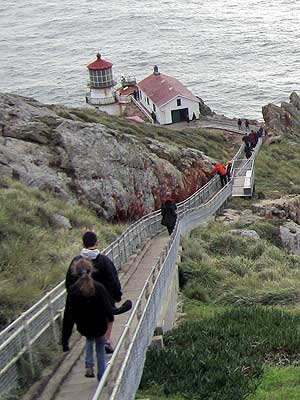
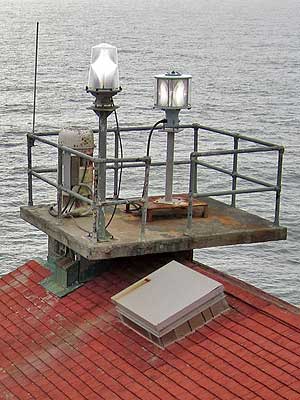
The path down ... The new automated signals
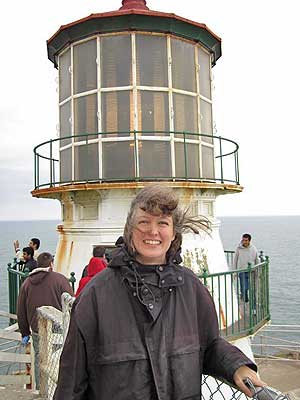
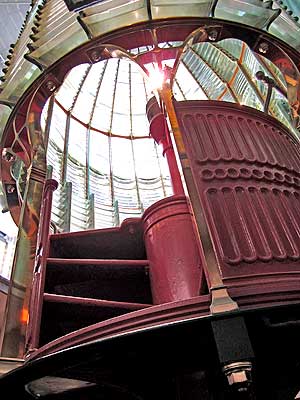
Point Reyes is the windiest place on the Pacific Coast and the second foggiest place on the North American continent! ... Inside the lighthouse is still the original 1st order Fresnel lens. Built in France in 1867, it weighs around 6,000 pounds. It revolved at the rate of one revolution every two minutes and produced a white flash once every five seconds.
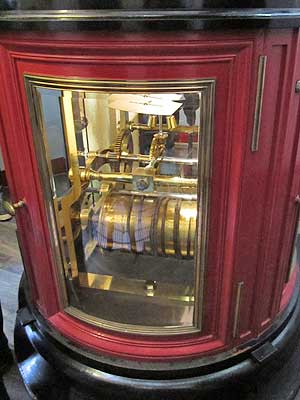
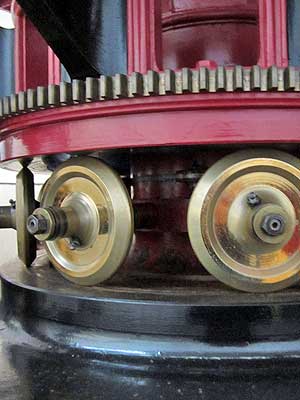
The original clockwork mechanism embedded in the cast iron housing and... the large rotating wheels at the bottom
-- FLORIDA (Ponce de Leon Inlet) --
Ponce de Leon Inlet Light
Atlantic Ocean (east) and Halifax River as part of the Intracoastal Waterway (west)
Built 1835 • Height 175 feet • 1st & 3rd order lenses
The Mosquito Inlet Light (changed to the Ponce de Leon Inlet Light in 1927) was first erected in 1835. Unfortunately, oil for the eleven lamps in the lantern room was never delivered and the 45-foot tower was weakened from a strong storm later that year. It was then attacked by Seminoles, who smashed the glass in the lantern room and set fire to its wooden stairs. The area was abandoned. War with the native tribe prevented its repairs and it collapsed the following year.
In spite of the many shipwrecks here, it wasn't until 1887 that another one was completed. The light could be seen from 20 miles (or 17 nautical miles) away. At a height of 175 feet, it is the tallest lighthouse in Florida. A brick foundation extending 12 feet below ground supports the massive tower. In 1933, the lighthouse was electrified and the 1st order Fresnel lens (constructed in 1867 in Paris) was replaced with a smaller 3rd order rotating one. It was under ownership of the US Coast Guard from 1939 to 1970, at which point it was abandoned after a new beacon was established at New Smyrna Beach. It was acquired by the town in 1972 and restored.
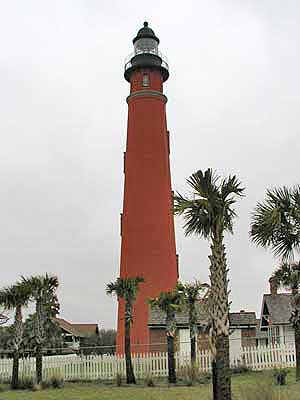
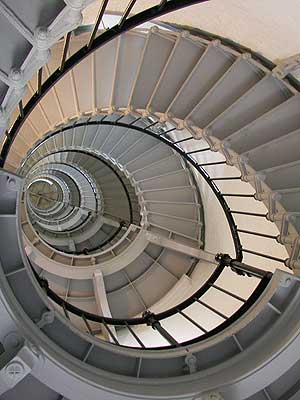
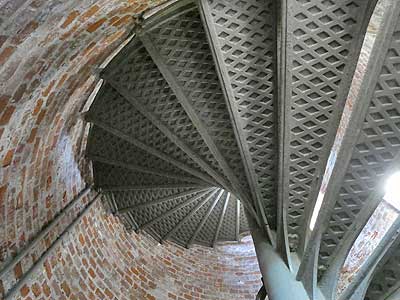
A 194-step circular stairway leads to the top.
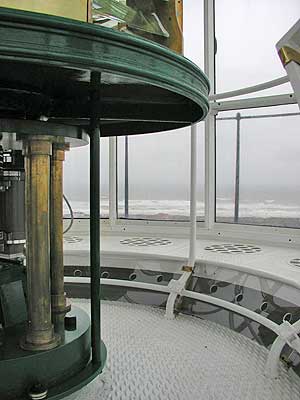
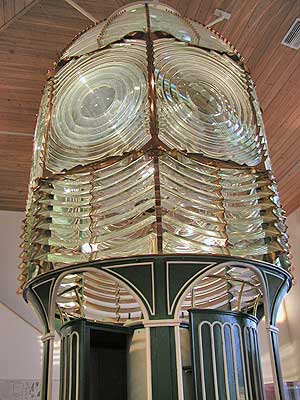
The lantern room ... In the museum, the 1st order lens from the Cape Canaveral Lighthouse stands over 16 feet tall and weighs over 12,000 pounds.
-- NEW JERSEY (Highlands) --
Navesink Twin Lights
entrance to New York Harbor (Atlantic Ocean)
Built 1862 • Height 246 feet • 2nd & 6th order lenses (north tower) and 1st order lens (south tower)
The Navesink Twin Lights are a pair of lighthouses located 246 feet above sea level on the headlands of the Navesink Highlands. A pair of beacons have existed here since 1828 to help ships navigate the treacherous entrances to New York Harbor. The current structure was constructed in 1862. Each tower had a different light... one flashing and one fixed. In 1898, the north tower light was discontinued while the south tower was electrified. It was automated in 1949 but discontinued in 1952 as its importance diminished. It was acquired by the state in 1962.
This lighthouse boasts a lot of firsts. In 1841, it was the first American lighthouse to test a Fresnel lens. In 1883, it was the first to change its lamp fuel from lard oil to mineral oil (kerosene). In 1893, its south tower received the seven-ton bivalve Fresnel lens that had been on display at the World's Exposition in Chicago. But it was designed to use electricity. So in 1898, it was became the first electrified coastal light with the most powerful beacon in the country.
Overpowered by the new lens in the south tower, the light in the north tower was discontinued, but it was kept in place in case the electricity to the south tower ever failed. The new light was so bright, however, that the locals complained they could not sleep, their chickens wouldn’t lay eggs, and even their cows refused to give milk. It also messed with migrating birds. So the back three panels of the lantern room were darkened. The keepers had to wear special welder's goggles when working near the light.
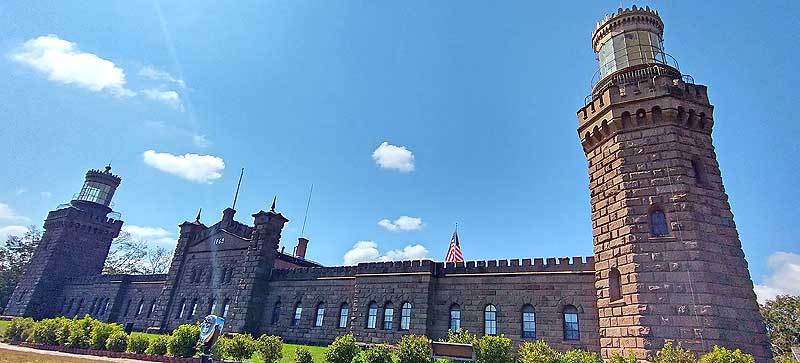
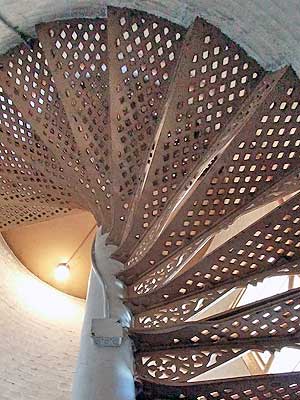
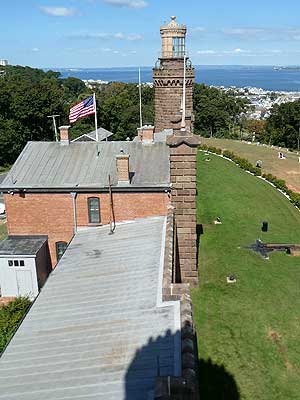
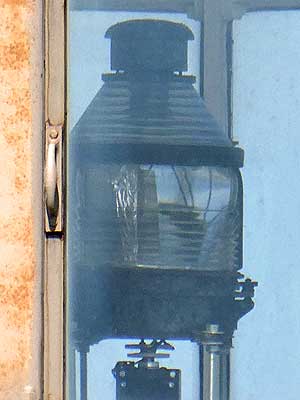
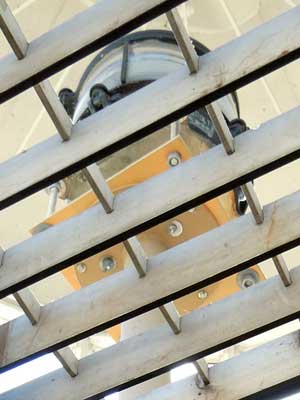
We could climb all the way up into the empty lantern room of the south tower but only up to walkway below the lantern room in the north tower, where a small 6th order lens still serves as an aid to private navigation.
-- NEW JERSEY (Sandy Hook) --
Sandy Hook Lighthouse
Lower New York Harbor (Atlantic Ocean)
Built 1764 (oldest working lighthouse) • Height 103 feet • 3rd order lens
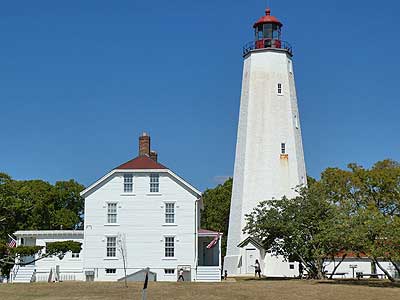
Originally called the New York Lighthouse (even though it was built on New Jersey land), the 85-foot-tall Sandy Hook Lighthouse is the oldest, sill operating lighthouse in the US. The Boston Light of 1716 was the first, but the original structure was destroyed and rebuilt. Built using funds from lotteries and prominent local merchants in the Colony of New York in 1764, it charged a tax on ships coming into the port to support its upkeep. In 1776, Americans tried to destroy it using cannons in an effort prevent the British from acquiring it. They were unsuccessful. After the Revolutionary War, it was one of the 12 lighthouses ceded to the new federal government, thereby quelling any dispute between New York and New Jersey as to ownership.
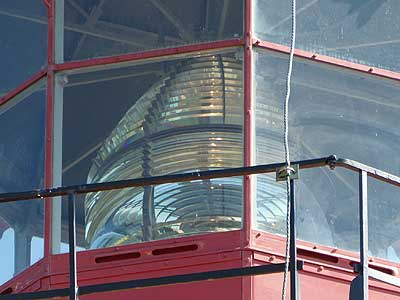
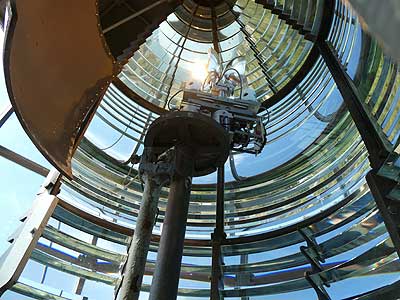
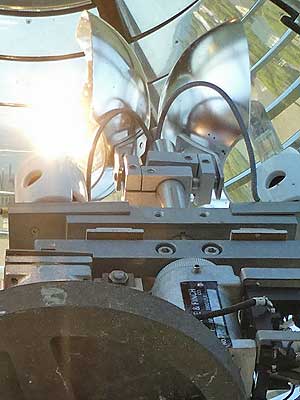
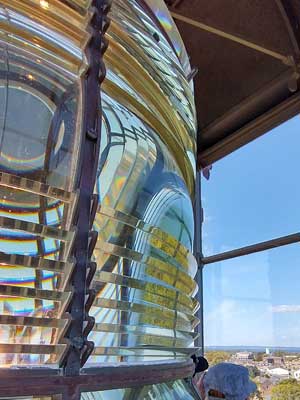
The original Fresnel lens shipped from France in 1840 was too large to fit inside the lens house so it was transferred over to the Twin Lights in Navesink, making it the first American lighthouse to use such a lens. Sandy Hook was refitted with its present 3rd order lens in 1857 when the iron lens house was added to the tower. In 1889, it became the first US lighthouse to be lit by incandescent lamps. Today it is equipped with a 1,000-watt bulb, making the light visible up to 19 miles on a clear day.
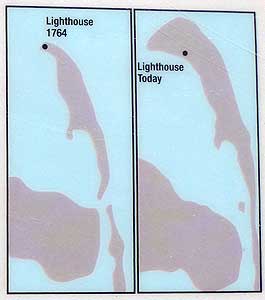
The low-lying spit of Sandy Hook has grown thanks to the current that drives sand to the north. The lighthouse was originally 500 feet from the tip. Today it is 1.5 miles away and landlocked.
-- SOUTH CAROLINA (Little River) --
Governor’s Lighthouse (honorary)
Coquina Harbor (Intracoastal Waterway)
Built 1985 • Height 50 feet
Lightkeeper's Village is a private community in Little River. At the edge of it stands the Governor’s Lighthouse, commissioned in 1984 by Governor Richard Riley to honor all of South Carolina governors. This is just an honorary monument, however, not a real lighthouse built by a government agency, and as such, it can not be used as a navigational aid for ships.
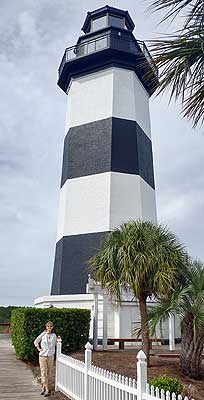
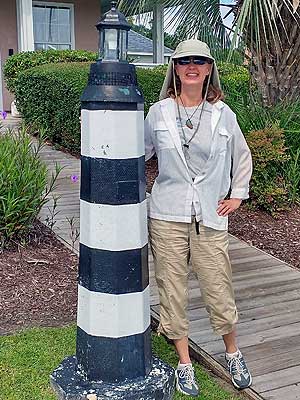
The real version ... and a small copy nearby
-- WASHINGTON (Hansville) --
Point No Point Lighthouse
Admiralty Inlet (Puget Sound)
Built 1879 (oldest in Puget Sound)• Height 30 feet • 5th & 4th order lenses
By the 1860s, lighthouses were being established along Washington’s west coast, but there were still no lights in Puget Sound. By the end of 1879, the Point No Point Lighthouse was nearing completion, but the lens and glass panes had not yet arrived. So the keeper simply hung a common kerosene lantern in its place until a 5th order fixed Fresnel lens arrived the following year. With no roads to the lighthouse for its first 40 years, supplies had to be brought in by boat. In 1915, the light source was upgraded to a 4th order flashing lens, which is still in place but no longer in use. The station was automated in 1977, and Kitsap County acquired it in 1998 when the Coast Guard declared it as surplus.
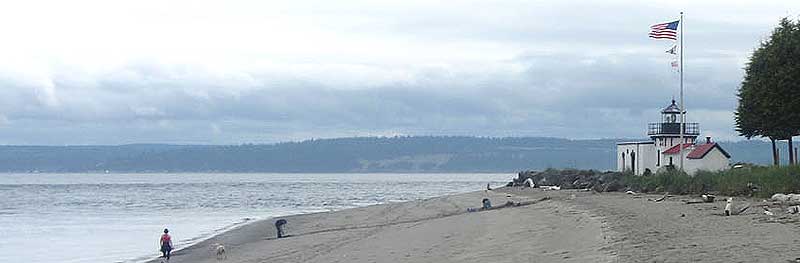
With its 30-foot tower, it is considered the oldest lighthouse on Puget Sound.